You Don’t Need to Sprint
But here’s the case for 20 minutes of 8:12 intervals anyway.
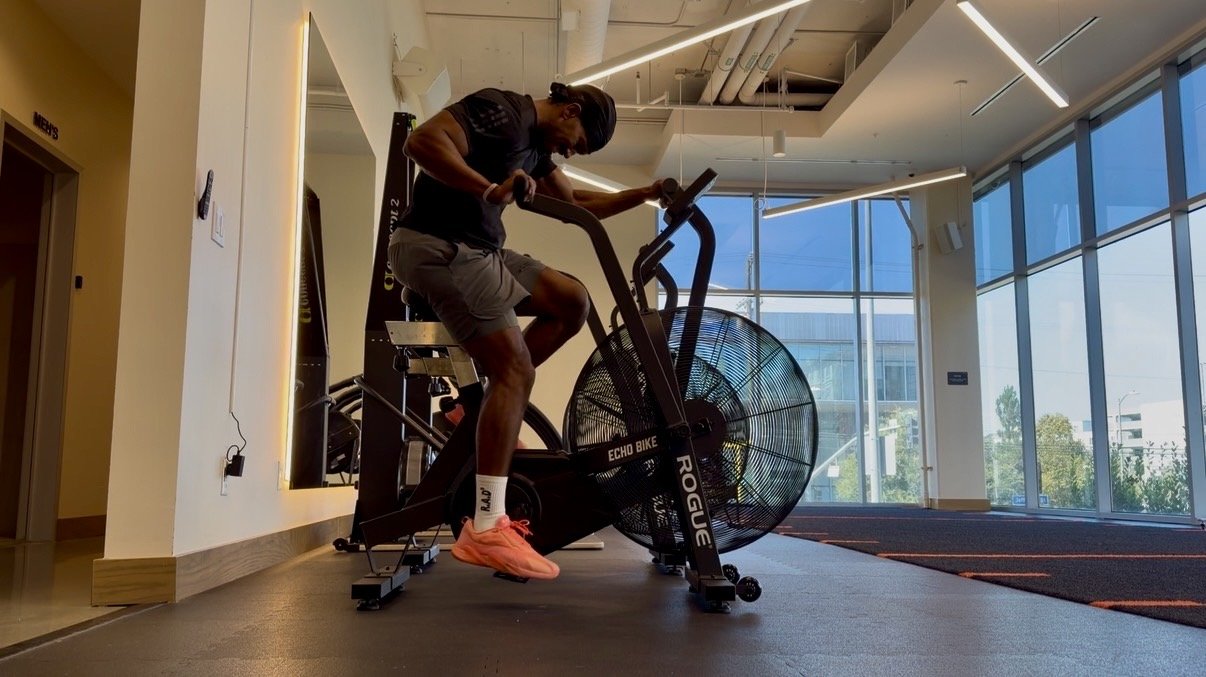
I discovered the format around 2016, though the science behind it goes back further. Exercise physiologist Gail Trapp first popularized it in 2010 with a landmark study on high-intensity intermittent exercise, and it’s a workout I keep returning to for one reason above all: its simplicity.
The Setup
Like many things in the fitness world, the simpler the format, the harder the application. And this one’s as straightforward as they come. Go hard — near-max effort relative to your own fitness — for 8 seconds, immediately followed by 12 seconds of slow, active recovery. Repeat for 20 minutes. If 20 minutes isn’t realistic yet, break it into smaller chunks and build toward it over time.
It’s best done on a fan bike, rowing erg, or ski erg because they’re machines where resistance responds instantly to effort, so there’s no lag between the effort you put in and what you get out. Fan bikes (Echo Bike, Assault Bike) are close to ideal since the resistance on these tools scales instantly and automatically with your effort, so the machine self-regulates without you touching or adjusting anything mid-interval. Rowing and ski ergs work the same way. And while a standard stationary bike works too, it just takes a bit more attention to set resistance high enough beforehand.
Treadmills are trickier than people expect. A standard motorized treadmill has real lag — the belt takes time to accelerate to sprint speed and time to decelerate back down, and you end up with a chunk of your “sprint” being the belt catching up to you. Non-motorized, self-powered (curved) treadmills solve this, since the belt only moves as fast as you drive it.
Outdoor sprints work too and are the most “natural” version of this, but they carry more soft-tissue injury risk since there’s no equipment to absorb impact the way a bike or erg does, which is important to consider if you’re deconditioned.
None of this is the only path to the same benefits, though. If a fan bike, rower, or ski erg isn’t accessible to you, there are other protocols that hit this same VO2 max mechanism through different work-to-rest math, and I’ll expound on a few of those down the line.
“Do I Actually Need to Sprint?”
I get asked this question regularly. Short answer: no. Worth stating plainly before making the case for why I still program this kind of work.
Major public health guidelines like WHO, ACSM, and AHA treat moderate and vigorous-intensity activity as roughly interchangeable: 150 minutes of moderate activity per week, or 75 minutes of vigorous, or some blend of the two. That’s not an arbitrary rule of thumb. A 2020 systematic review and meta-analysis looked specifically at whether vigorous activity reduces all-cause mortality more than moderate activity once total volume is controlled for, and found no significant difference.1
Consistency and total volume of movement — at whatever intensity you’ll actually sustain — do more for your health than none at all.
That said, sprint-style intervals do have a specific, legitimate edge, and it’s worth understanding what it is and isn’t.
Why I Will Sprint or Die Trying
1. Time efficiency. You get more “bang for your buck” — more benefit per minute of work — than steady-state or moderate activity. On days where you only have 20–30 minutes to get in some activity, this is right there waiting for you. Get into it, and get on with your day.
2. VO2 max. This is one of the biggest signals of cardiorespiratory fitness, and a genuinely reliable predictor of longevity. A 2018 study following more than 122,000 adults found cardiorespiratory fitness was inversely associated with long-term mortality with no observed ceiling. The fittest group had roughly an 80% lower mortality risk than the least fit.2 You tend to plateau on VO2 max gains from moderate-intensity training fairly quickly, and workouts that push you to near-max effort are a sound, time-efficient way to keep raising that ceiling.
And once you’ve raised it as far as it’ll go, the work still isn’t wasted. VO2 max declines with age no matter what, but how fast it declines is largely up to you. Masters athletes who keep training lose it at roughly half the rate of their sedentary peers, while stopping altogether can cost you as much as 20% in a matter of months.3 Continuing to train this way helps your VO2 max avoid taking a cliff dive.
3. Fat loss. Sprint-style intervals like this tend to support greater fat loss than steady-state cardio, largely through greater fat oxidation, which is the process by which your body uses oxygen to break down stored fat into usable energy. Interestingly, the original research on the 8:12 protocol highlighted this distinctly: in a 15-week trial of young women, the interval group saw significant reductions in total body mass, fat mass, and fasting insulin, while a steady-state group matched for effort didn’t, even though both groups improved cardiovascular fitness similarly.4 The research isn’t unanimous on how big that edge is, though, and some later reviews find the fat-loss advantage over steady-state is smaller or less consistent than early studies suggested. But the direction holds up overall.
4. Insulin sensitivity. Think of insulin like a key: when you eat, it unlocks your muscle and liver cells so they can take up glucose from that food and convert it into usable energy. Poor insulin sensitivity can contribute to type 2 diabetes, heart disease, and weight gain. High-intensity intermittent training like this has repeatedly been shown to improve insulin sensitivity and lower fasting insulin, including in that same original study.5
5. Approachability. This one’s more my own coaching take than something backed by a specific study. I like keeping bursts to 8–10 seconds because that window relies mostly on your body’s immediate energy stores, rather than the metabolic system that kicks in the longer an effort stretches. This allows you to get a genuine near-max effort without digging as deep a fatigue hole. In my experience, “go hard for a few seconds” is a much easier sell to someone intimidated by the word “sprint” than asking them to hold that effort for 20–30 seconds. And as you get better, you can increase your output accordingly.
One huge point of clarification for anyone who’s heard the phrase “lactic acid burn” (which was honestly me not even that long ago): that’s actually a myth. Lactate isn’t what causes the burning sensation during hard efforts. It comes from a buildup of hydrogen ions and other byproducts, and lactate itself may even help buffer that acidity. Important to note mostly because it means the goal of short bursts isn’t “avoiding lactate” — lactate is a normal, even beneficial part of training — it’s limiting the broader fatigue and discomfort that build up the longer you sustain hard effort.
The Bigger Picture
I’m always thinking about how to translate bigger, more complex principles into something both gym-goers and non-gym-goers find digestible and approachable. I’m drawn to this specific style of conditioning because, at the end of the day, it’s hard work — but life is hard, and I think we benefit from consciously considering which kind of hard we’d rather contend with: the hard work of keeping our bodies pliable and adaptable to what’s already on our plate, or the potentially harder future we back into by avoiding a little hard work today.
Who’s to say the future holds any real hardship like that, and I hate leaning on a doomsday framing to motivate anyone to move today. But it’s a reality worth acknowledging, especially in a Western world where divorce rates are climbing and more adults are staying single further into life, often without the built-in support systems previous generations relied on, which means you may need to be physically equipped to take care of yourself for longer.
So consider this a way to bite off just enough that you can chew, until your appetite grows to go after more.
References
- Do vigorous-intensity and moderate-intensity physical activities reduce mortality to the same extent? A systematic review and meta-analysis (2020).
- Mandsager K, Harb S, Cremer P, Phelan D, Nissen SE, Jaber W. Association of Cardiorespiratory Fitness With Long-term Mortality Among Adults Undergoing Exercise Treadmill Testing. JAMA Network Open. 2018;1(6):e183605.
- Trappe SW, Costill DL, Vukovich MD, et al. Decline in VO2max with aging in master athletes and sedentary men. Journal of Applied Physiology. 1990;68(5):2195–2199. See also: The Impact of Training on the Loss of Cardiorespiratory Fitness in Aging Masters Endurance Athletes (2022).
- Trapp EG, Chisholm DJ, Freund J, Boutcher SH. The effects of high-intensity intermittent exercise training on fat loss and fasting insulin levels of young women. International Journal of Obesity. 2008;32(4):684–691.
- Boutcher SH. High-Intensity Intermittent Exercise and Fat Loss. Journal of Obesity. 2011;2011:868305.
Want help putting this into practice?
I work with people one-on-one in Los Angeles and remotely. If something here landed, let's talk about what a plan built around you looks like.